Ask for the Google Review While They're Still Standing There
The best moment to ask for a Google review is while the customer is happy and in front of you. Exact wording, the mechanics, and how to reply to bad reviews.
A customer just told you the haircut was perfect. Or the pasta was the best they've had in months. Or that you fixed in twenty minutes what two other guys couldn't figure out.
That is the moment. Not tomorrow in an email. Not next week in a text blast. Right then, while they are standing at your counter with their wallet out and a good feeling in their chest.
Most businesses let that moment pass every single day. Then they wonder why they have eleven Google reviews and the place down the street has two hundred.
Reviews come from asking, and almost nothing else
There is a myth that good service generates reviews on its own. It does not. Good service generates satisfied customers who go home and forget about you, because their day has other things in it.
The people who write reviews unprompted are usually at the extremes. Someone furious about a cold soup. Someone who is a habitual reviewer and does it everywhere. The enormous middle — the regulars, the happy-enough, the people who would say something nice if someone asked — never writes anything, because nobody asked.
So your review count is not a measure of how good you are. It is a measure of how often you ask. Two restaurants of identical quality will have wildly different star counts based on nothing but whether the staff opens their mouth.
Why the in-person moment beats every other channel
Email asks get opened at low rates and acted on at lower ones. Text asks do better but feel intrusive to some people. A sign on the wall gets read by nobody.
The in-person ask works because three things line up at once. The experience is fresh, so they actually have something to say. There is a human in front of them, so declining feels slightly awkward in a way an unopened email never does. And they have their phone within arm's reach, because everyone always does.
Miss that window and the quality of the review drops too. A review written three days later is vague: "Good food, nice service." A review written in the parking lot names the dish, names the server, mentions the thing that made the visit good. Those are the reviews that convince strangers, because they read like a real person and not a template.
The exact words your staff should say
Give your team a script. Not because they are incapable of improvising, but because most people feel weird asking for a favour and will skip it entirely unless you hand them the sentence.
A restaurant version, at the point of payment or as you drop the bill:
"Really glad you enjoyed it. If you have twenty seconds, a Google review helps us a lot — most people find us that way."
A salon version, while the client is checking the back with the mirror:
"If you're happy with it, would you mind leaving us a Google review? It's the main way new clients find us."
A trades version, standing at the truck after the job:
"One thing that would help me — a quick review on Google. I'll text you the link right now so you don't have to hunt for it."
What makes these work:
- They follow a positive signal. Only ask when the customer has already said something good. Asking a grumpy customer for a review is asking for a one-star.
- They name the time cost. "Twenty seconds" removes the fear of a homework assignment.
- They give a reason. "Most people find us that way" is true and it makes the ask about survival, not vanity. People help small businesses they like.
- They are short. No speech. One sentence, then stop talking and let them answer.
One more rule: ask once, then drop it. If they say "sure, I'll do that later," thank them and move on. A second ask turns a warm customer cold.
The mechanics: make it one tap
The ask is half the job. The other half is removing every obstacle between "yes" and a posted review.
Get your short review link. Google gives every business profile a direct review link that opens the star-rating box straight away. You can find it in your Google Business Profile dashboard under the option to ask for reviews. Copy it. Shorten it if you like. That link is the only one anyone on your team should ever send.
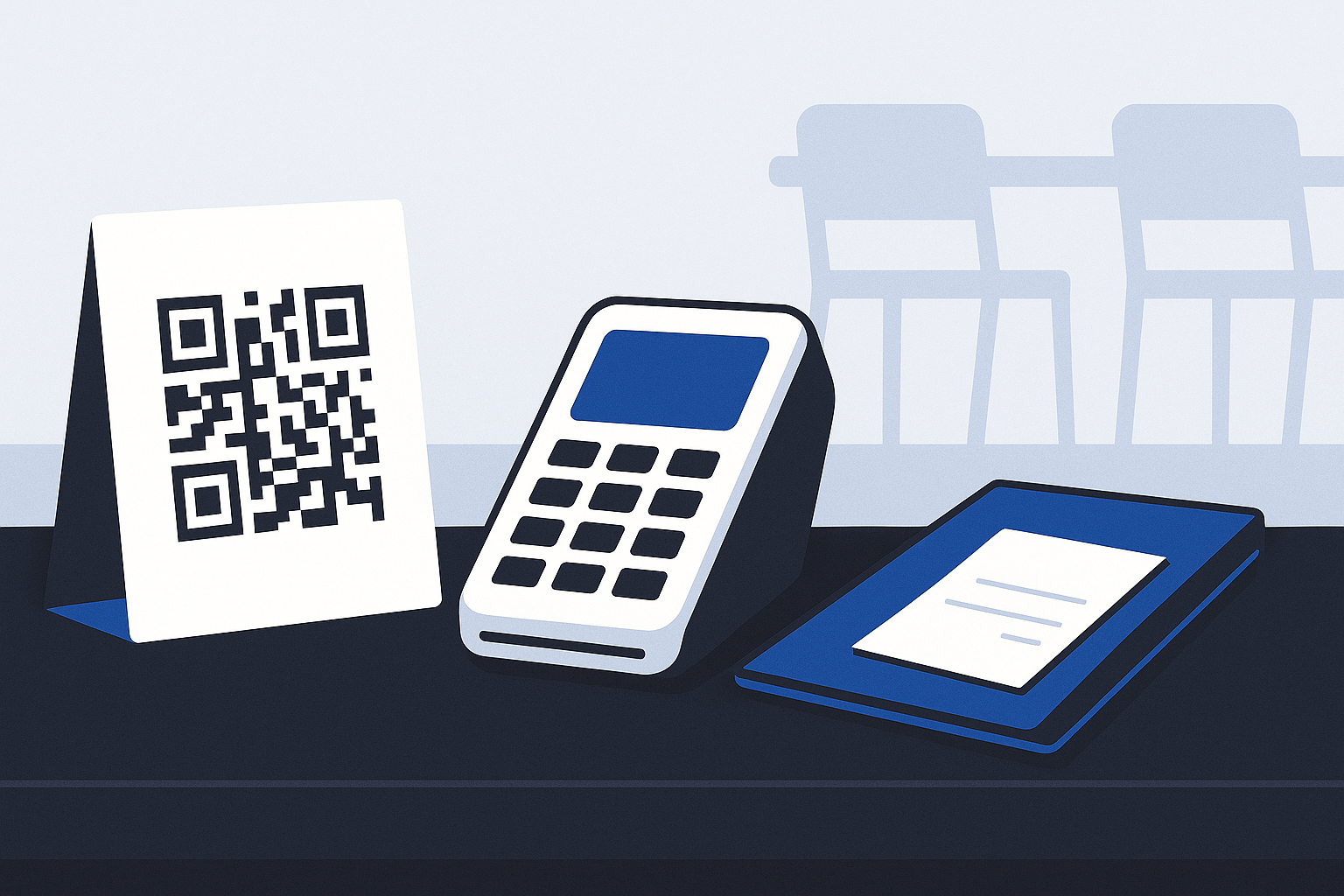
Put a QR code on the counter. A small card or a decal by the register, pointed at that same link. The QR is not the ask — it is the thing you point at during the ask. "Scan that and it'll take you right there." Never rely on the QR alone to do the work.
Text the link for service jobs. If you're in someone's home or their driveway, you already have their number. Send the link before you leave, while you're both still standing there. "Just sent it to you" is a soft nudge that costs nothing.
Never hand over your own device. Do not slide a laptop across the desk. Do not pass your phone. Reviews written on a business's own device look suspicious to Google and feel coercive to the customer, who now has to write something nice with you watching. Their phone, their words, their pace.
Do not offer anything in return. No free coffee, no discount, no draw entry. Incentivized reviews violate Google's policies and can get your reviews stripped or your profile flagged. The upside is small and the downside is losing the reviews you already earned.
Build the ask into a shift, not a campaign
Campaigns fade after two weeks. Habits don't. A few ways to make it stick:
- Add it to the closing sequence the way you'd add wiping down a station. "Ask every table that compliments the food" is a line item, not an initiative.
- Mention review count at your weekly staff check-in. Not as pressure — just say the number out loud. What gets counted gets remembered.
- Post the exact script somewhere staff can see it. Back of the register, inside the cabinet door.
- Train new hires on it in their first week, alongside how to run a card.
Steady beats spiky. Google notices a natural trickle of reviews over months and treats it as a live business. Forty reviews in one week followed by silence looks like what it is.
Replying to bad reviews is a sales channel
Here is the part most owners get backwards. You think the reply is for the angry customer. It is not. That person is gone, and probably not coming back.
The reply is for the next forty people who read that review while deciding whether to call you. They will read the complaint, then read your response, and judge you almost entirely on the response. A calm, specific reply to a harsh review does more for your credibility than three five-star raves.
What a good reply does:
- Answers within a couple of days. Late replies read as damage control.
- Names the specific issue. "Sorry you waited forty minutes on Saturday" beats "Sorry you had a bad experience."
- States what changed. "We've added a second person to the pass on weekends." Concrete, verifiable, forward-looking.
- Offers to take it offline once. A phone number or email, then stop. Do not argue in public, ever.
- Stays short. Three or four sentences. Long replies look defensive no matter how right you are.
What kills you: sarcasm, blaming the customer, correcting details, or the phrase "we pride ourselves on." A reader who is on the fence will read a defensive reply and picture what happens when they have a problem.
Reply to the good ones too, briefly. It signals that a real person reads them, which quietly encourages more.
Where reviews actually land
Reviews feed your Google Business Profile, which for most local searches is the first thing anyone sees — often before your website. If you haven't thought about that profile as a real storefront, start with why your Google Business Profile is your real homepage. Reviews are the part of it you have the most direct control over, and the part you can improve starting with your next customer.
The gap between a business with 15 reviews and one with 150 is rarely quality. It is a sentence somebody remembered to say. If you want help tightening the whole chain — the profile, the site people land on afterward, the phone that has to answer when they call — that is what our services cover. But the asking part is free, and it starts on your next shift.