The Bookkeeping Habit That Makes Your Accountant Cheaper
Most accounting bills are inflated by sorting, not accounting. Here's a 15-minute weekly bookkeeping habit that shrinks the invoice.
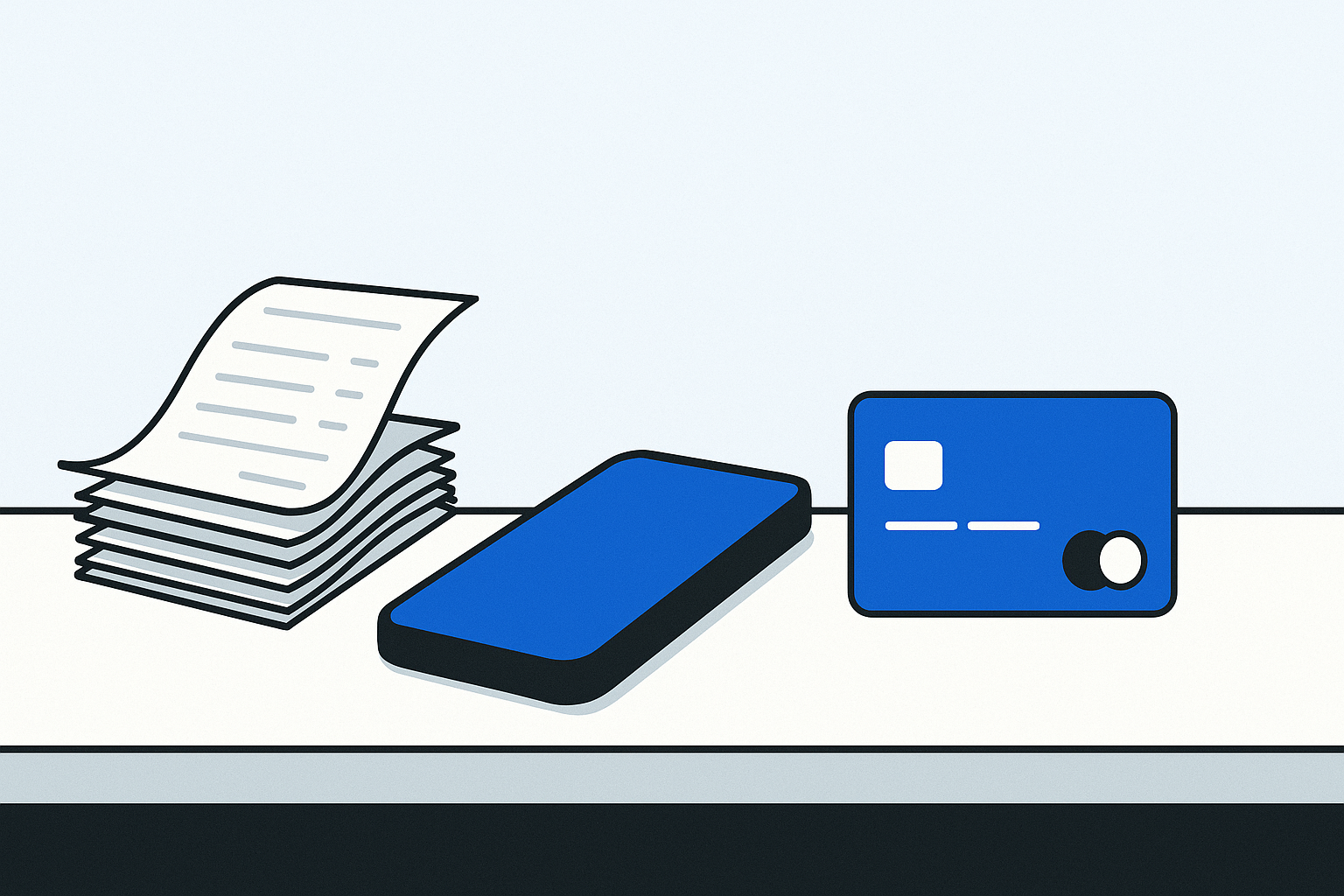
Your accountant is not expensive because accounting is hard. Your accountant is expensive because someone in that office spent four hours opening a shoebox, flattening thermal receipts, squinting at a faded one from a hardware store in March, and guessing whether the $212 charge on your personal Visa was inventory or your kid's hockey registration.
That guessing is billed at the same rate as the actual tax work. It shouldn't be. It's sorting, and sorting is something you can do in fifteen minutes a week while the coffee brews.
This is an organizing article, not tax advice. We run a restaurant and we've been on the wrong end of a year-end invoice more than once. What follows is a filing habit. For anything about what's deductible, what rate applies to you, or how to handle a specific transaction, talk to a licensed accountant or bookkeeper. That's their job and they're good at it when you let them do it.
The bill is mostly cleanup, not thinking
Here's the shape of a typical year-end for a small operator who never built the habit. The accountant gets a bank export, a pile of photos, a credit card statement, and a text that says "I think that one was for the patio." They have to reverse-engineer a year of your decisions from the outside. Every unclear line becomes an email to you. Every email you don't answer for three days becomes a follow-up. All of it is time, and time is the unit they bill in.
Now the version where the habit exists. The accountant gets a clean set of categorized transactions with receipts attached. They check it, ask about the four things that are genuinely ambiguous, and file. The thinking part — the part you're actually paying for — is the same amount of work either way. The cleanup part shrinks to almost nothing.
You can't make the thinking cheaper. You can delete the cleanup.
One business account. No exceptions.
If you take one thing from this: stop mixing personal and business money.
One business chequing account. One business credit card. Everything the business earns goes in. Everything the business spends comes out. When you want money for yourself, you move it from the business account to your personal account in one clean transfer, and you talk to your accountant about how that transfer should be recorded for your particular setup.
The reason is not virtue. The reason is that a mixed account forces someone to make a judgment call on every single line. Four hundred lines, four hundred judgment calls, and the person making them doesn't know your business. A clean business account means the default answer is "this is business," and only the rare exception needs a second look.
The same goes for the card. If you buy supplies on whichever card is in your pocket, you've created a second pile that has to be reconciled against the first. One card. Keep it in the drawer at the restaurant or the salon if you have to. Staff who buy supplies get that card or they get reimbursed through a single documented process — not a stack of receipts handed to you in a crumpled envelope at 11pm.
If you're just starting out and haven't opened a business account yet, do that this week. It's the single highest-leverage hour in this entire article.
Photograph the receipt at the counter, not at the desk
Thermal paper fades. The receipt from the restaurant supply store will be a blank grey rectangle by August. This is not a theory, it is a chemical fact about the paper, and every operator who has opened a drawer in February and found blank slips knows it.
So photograph it where you're standing. At the counter, before the receipt goes in your pocket. Phone out, picture, done. Six seconds.
Where the photo goes depends on what tools you already use. Most bookkeeping apps have a phone app that lets you snap and attach. If you don't use one, a single shared folder in your cloud drive works fine — name it by year and month and nothing else. The point is that it's one place and you never have to decide where it goes. Decisions are what kill habits.
Two details that save you later:
- Get the whole receipt in frame, including the top with the vendor name and the bottom with the tax lines. A cropped photo of just the total is almost useless.
- If it's a cash purchase, say what it was. Most receipt apps let you add a note. "Produce, Saturday market" takes four seconds and answers a question your accountant would otherwise have to ask you in November.
The fifteen minutes
Pick a day. Not Monday morning if you're a restaurant — Monday morning belongs to your weekly numbers. Pick a slow hour mid-week and put it in your calendar as a repeating event, the way you'd schedule a delivery.
In that fifteen minutes you do exactly three things:
Match. Open your bookkeeping tool. Every transaction from the week that came through the bank or card is sitting there waiting. Match each one to a receipt photo. Most tools do this automatically and you're just confirming.
Categorize. Assign each transaction to a category. Food cost, supplies, rent, utilities, software, professional fees — whatever list your accountant gave you. If they haven't given you one, ask for it. A two-minute phone call that gets you their preferred category list will save them hours later, which means it saves you money.
Flag. Anything you're unsure about, flag it and move on. Don't stall out trying to figure out whether the new espresso machine is an expense or an asset. That's a real question with a real answer and it's the accountant's answer to give. You just need a short list of flagged items instead of four hundred unknowns.
Fifteen minutes covers a week of transactions for most small operators. If it's taking an hour, you have too many accounts or too many cards. Go back to the previous section.
HST rhythm, at a high level
If you're registered for HST, you're collecting tax on sales and paying tax on purchases, and on a schedule — monthly, quarterly, or annually depending on your situation — you file and remit the difference. Your accountant or the CRA will tell you which schedule applies to you.
The habit matters here more than anywhere else, for one reason. The tax you collect was never your money. It sat in your account looking like revenue, and if your books are a mess you genuinely do not know how much of your balance is yours. Owners get caught by this constantly: the filing deadline arrives, the number is bigger than expected, and the cash isn't there.
The fix is the same fifteen minutes. When your books are current, you can see what you've collected and what you've paid at any point in the period. Some operators move the collected amount into a second account as they go so it stops looking spendable. Whether that's right for you is a cash-flow conversation to have with your accountant — but you can't have that conversation at all if nobody knows the number.
Filing itself is not the hard part. Knowing the number before the deadline is the hard part, and that's a filing habit, not an accounting skill.
What this buys you
Call your accountant and ask one question: "If I hand you clean, categorized books with receipts attached, what does that change about your fee?" Most will tell you straight. Some bill year-end as a flat fee that assumes cleanup and will quote lower without it. Some bill hourly and the saving shows up directly.
The second thing it buys you is a business you can actually see. Food cost as a percentage. What you're really paying for software you forgot you subscribed to. Which delivery platform is quietly eating your margin. None of that is visible in a shoebox.
A lot of what we build at Webonology exists to reduce exactly this kind of manual retyping and re-sorting — order systems that push straight into your POS, phone agents that capture details so nobody writes them on a napkin. If the back office is where your week disappears, that's worth a conversation about what can be automated. But the bookkeeping habit itself costs nothing but fifteen minutes and a decision to stop mixing accounts.
Start this week. Photograph the next receipt at the counter.